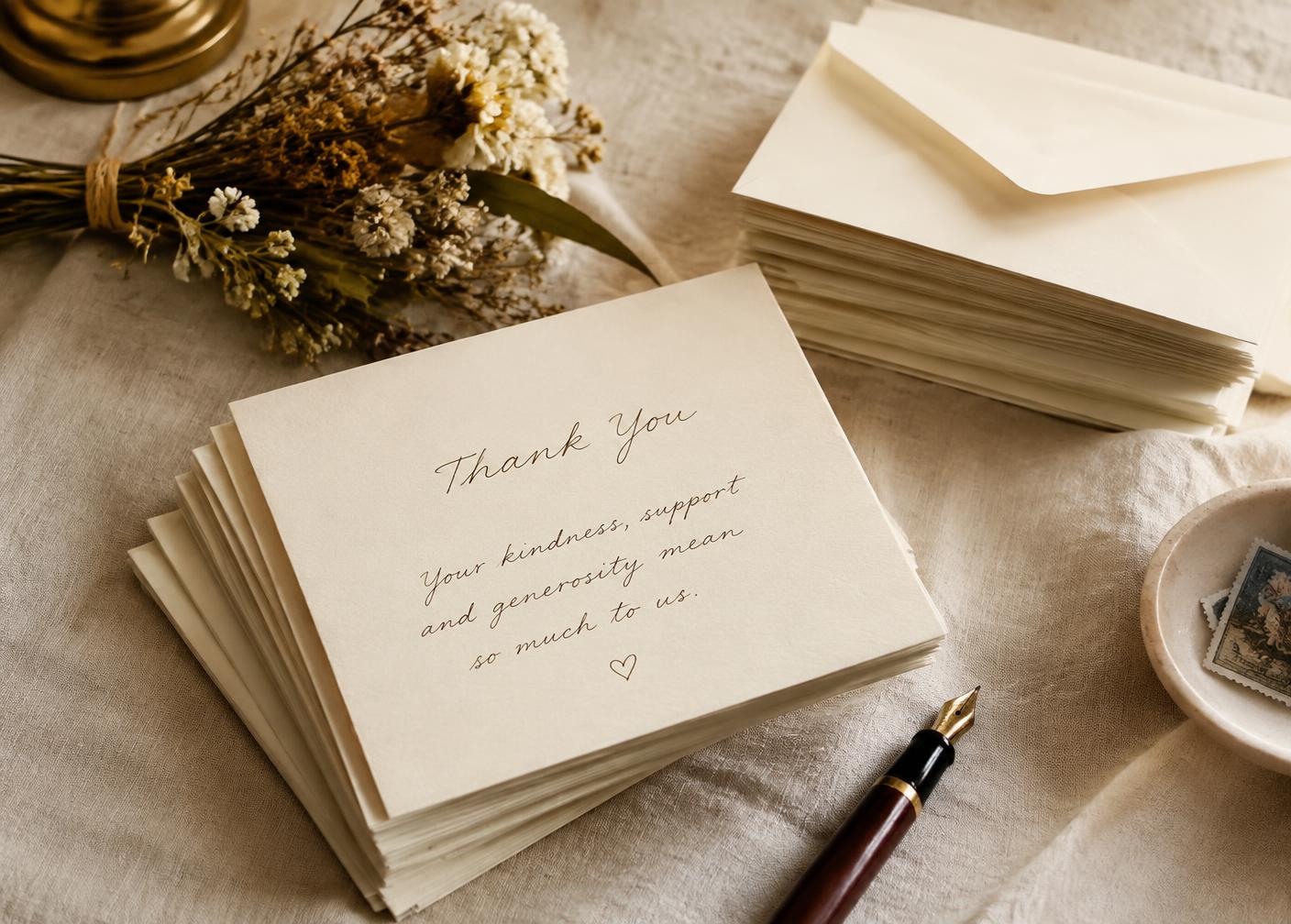
Thank you cards are the last thing most couples do, and often the part they dread. The dress has been cleaned, the photographs have arrived, and somewhere on the kitchen bench sits a list of ninety people who gave something, travelled somewhere, or carried part of the day for you. Writing to all of them feels enormous. It does not need to be.
A wedding thank you card does one job. It tells a person that you noticed them specifically. Everything else, the paper, the handwriting, the timing, matters far less than that.
When to send wedding thank you cards
The commonly repeated rule is within three months of the wedding. It is a reasonable target rather than a law. A card that arrives late still lands well; a card that never arrives is the only real mistake.
If the list feels unmanageable, send them in small batches. Ten cards on a Sunday morning over three or four weekends will finish the job without turning it into an ordeal. Start with anyone who travelled a long way or gave their time, because those are the people most likely to wonder whether their effort registered.
A simple structure that works every time
Most people freeze because they are trying to write something memorable. Aim instead for something specific. Four short parts will carry almost any card.
Open by naming what they gave or did. Say what it meant or what you will do with it. Add one line about them being there. Close warmly with both your names.
That structure fills a card in four sentences and never sounds like a form letter, because the first two lines can only be written about one person.
Wording for a gift
"Thank you for the serving bowls. They have already been used twice, including the first proper dinner we cooked in the new place. It meant a great deal to have you both with us on the day. With love, Amara and Josh."
If the gift is something you have not used yet, say what you are looking forward to rather than pretending otherwise. "We are saving these for the first Christmas we host" is honest and warm.
Wording for money
Money is the gift people find hardest to acknowledge, usually because naming the amount feels crude. You do not have to. Name the purpose instead.
"Thank you for your generous gift. It is going towards our trip to Japan in March, which we have wanted to do for years. Having you there made the day what it was."
Wording for people who helped
Some of the most important thank you cards go to people who gave no gift at all. The friend who drove three carloads of flowers. The aunt who ironed forty napkins. The cousin who quietly kept your grandmother company all night. These are the people most likely to be missed, and the ones we wrote about in the people couples forget to acknowledge.
"Thank you for everything you did before anyone arrived. I know how early you were there and how much you carried, and the day ran the way it did because of you. I will not forget it."
Wording for guests who travelled
"Thank you for coming all the way from Perth. We know what a weekend like that costs in time and money, and seeing you in the room was worth every bit of the planning. Thank you for the frames as well, they are already on the wall."
Wording when someone could not come
A card to someone who was missed is worth sending too, and it is often the one people remember longest.
"We missed you, and we thought about you more than once during the day. Thank you for the gift and for the message you sent that morning. Let us find a date soon."
Things that quietly weaken a card
Avoid opening every card with "thank you so much for your generous gift" and nothing else. It is polite and it is forgettable. Avoid apologising at length for writing late; one short line is plenty, and then move on to the person. Avoid writing the same sentence ninety times, which is what happens when you work from a template rather than from the list of who gave what.
Keep a running record during the wedding itself if you can. A named list of gifts, helpers and travellers, kept by someone you trust, makes this entire task take a third of the time. It is the same principle behind a wedding planning checklist that puts people first: the day goes better when someone is paying attention to the people.
Who should write them
Both of you. Not because tradition demands it, but because the cards read differently when they come from the person who knows the recipient best. Split the list by relationship rather than alphabetically. You write to your side, your partner writes to theirs, and each of you signs both.
The part most couples underestimate
Thank you cards are usually treated as an obligation to clear. They are actually the last chance the wedding gives you to say something directly to each person who showed up for you, and the only part of the day where you speak to them one at a time.
Most people keep them. That is worth remembering when you are on card fifty-two and running out of words. Say the true thing, say it plainly, and it will hold.
If you want the same feeling on the day itself rather than months afterwards, the small details guests actually remember is a good place to start, and what to write in a wedding card covers the wording when you are the guest rather than the couple.
wordthy exists for exactly this moment: helping people say what someone means to them while it still matters, rather than leaving it unsaid.